
In our last article, we left a question on the table.
Am I bringing the dog because they’ll enjoy it — or because I will?
Most of us move past questions like that quickly. They’re uncomfortable. They don’t have clean answers. So we let them slide and get on with our day.
In this article, we want to sit with it a bit longer. Because the answer – or the willingness to ask – is what separates bringing your dog along from actually being with them.
Where we stand
Before we go further, let’s be clear about something.
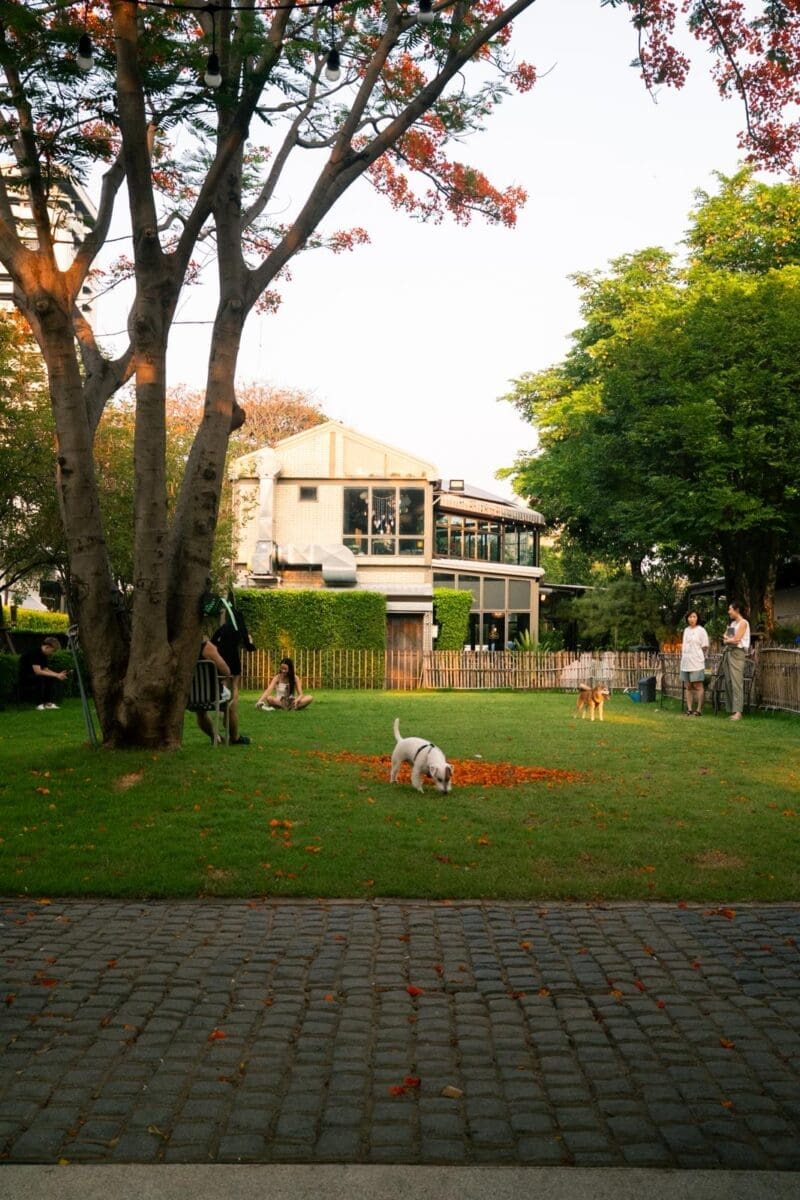
Pup Cities exists to help dogs become a bigger part of city life – more cafés, more parks, more shared space, more outings worth taking together. That’s the whole project, and it isn’t changing.
This post isn’t a step back from that. It’s a step deeper into it. The question we’re asking — what is this like for them? — is the question that makes everything else work. Because bringing your dog well matters more than bringing them often. It always has.
The easy assumption
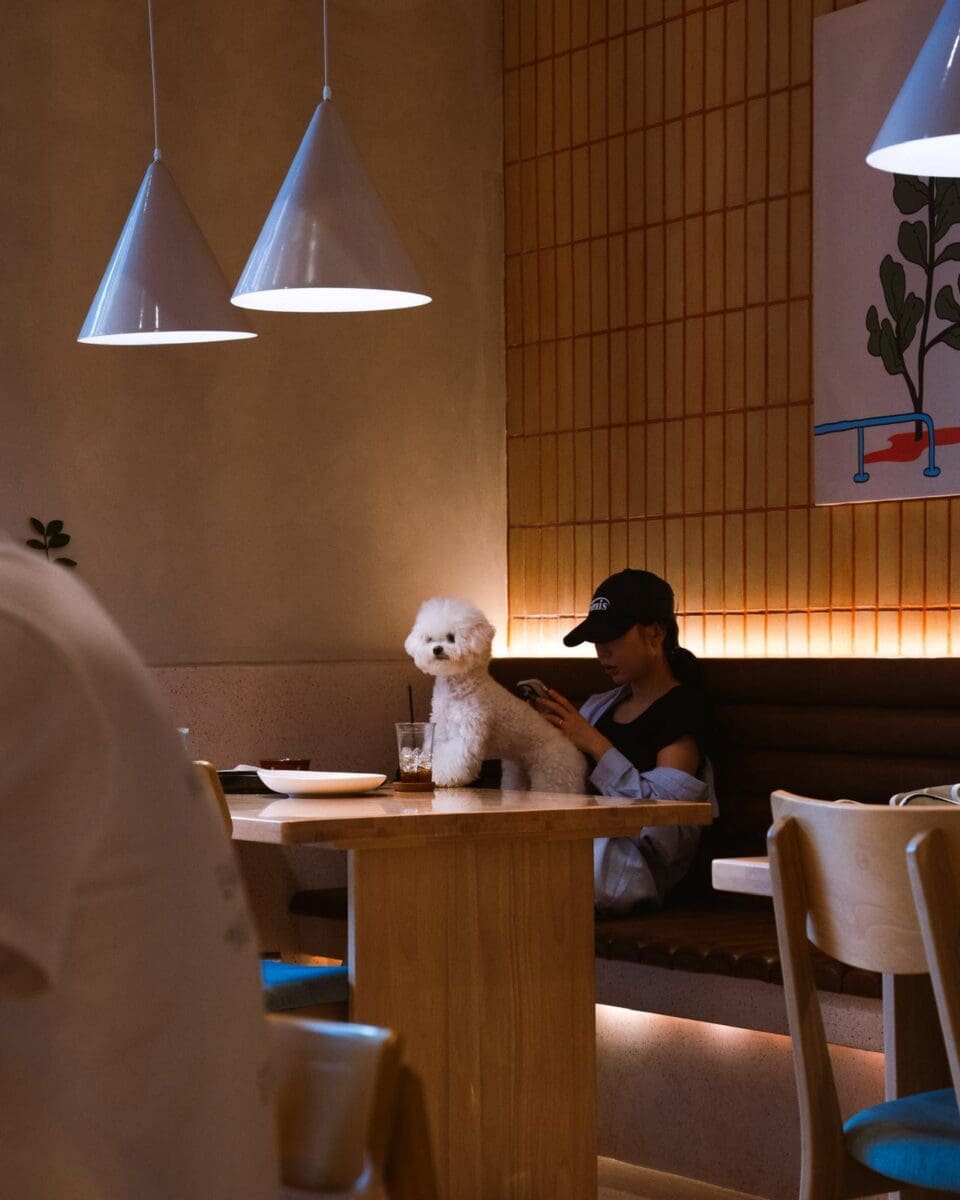
Here’s a thought experiment. You’re at a café you love. Your dog is on the chair beside you. The light is good, the company is good, the food is good. The dog is here with you. Therefore, the dog  must be having a good time.
That logic feels airtight. It isn’t. It has a hidden step in the middle.
The hidden step is this: it assumes your dog is experiencing the afternoon the way you are. That what’s pleasant for you is pleasant for them. That the things you’ve tuned out (the noise, the smells, the floor texture, the strangers at the next table) are tuned out for them too.
They’re not. And that’s not a flaw in your dog. It’s biology.
A different sensory world
If you’ve been following along with us, you’ll have met an idea we keep returning to: the dog’s umwelt. The cognitive scientist Alexandra Horowitz, in Inside of a Dog, uses this term to describe the dog’s own sensory world – fundamentally different from ours, not just a smaller or simpler version of it. We covered this in our last article. We’re returning to it here because it’s where the question of what is your dog getting out of this? actually has to be answered.
Here’s the move that matters for this article: once you accept that your dog’s experience of the café is genuinely different from yours, you have to give up a comforting assumption. The assumption is that your enjoyment is reliable evidence of theirs. It’s not. They are not having a smaller version of your afternoon. They are having a different afternoon entirely.
What does that actually mean in a café on a Saturday in Bangkok?

It means your dog is processing a tide of information you’ve filtered out before you even sat down. The smells of every other customer, every menu item, every cleaning product used overnight. The acoustic texture of a room you’ve stopped hearing. The visual layout of a space that’s roughly waist-height to you and overhead to them. The body language of every person who walks past. The presence of every other dog within a 50-metre radius, whether visible or not.
Some dogs handle this beautifully. Some dogs find it interesting. Some find it overwhelming. Some find it overwhelming on Saturday but fine on Tuesday at 3pm. The umwelt concept doesn’t tell you which one your dog is. What it tells you is that the question is real — that there’s actually something to ask, and your dog’s experience isn’t just a quieter version of your own.
That’s the whole reason this article exists. Once you take the difference seriously, you can’t go on assuming. You have to start looking.
What this looks like in practice
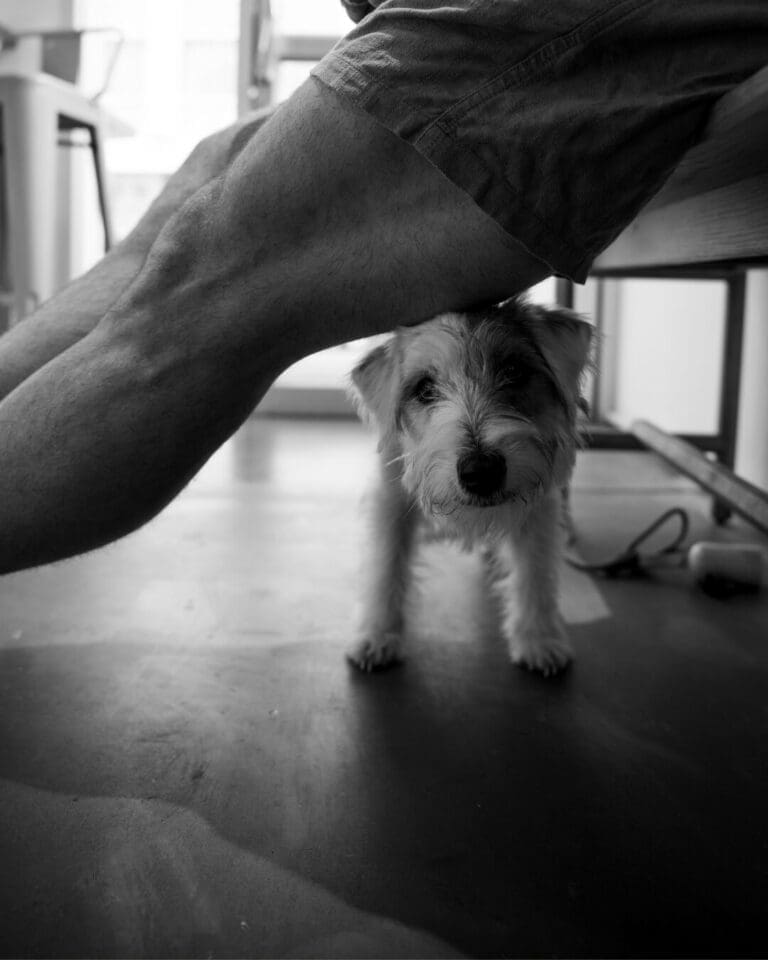
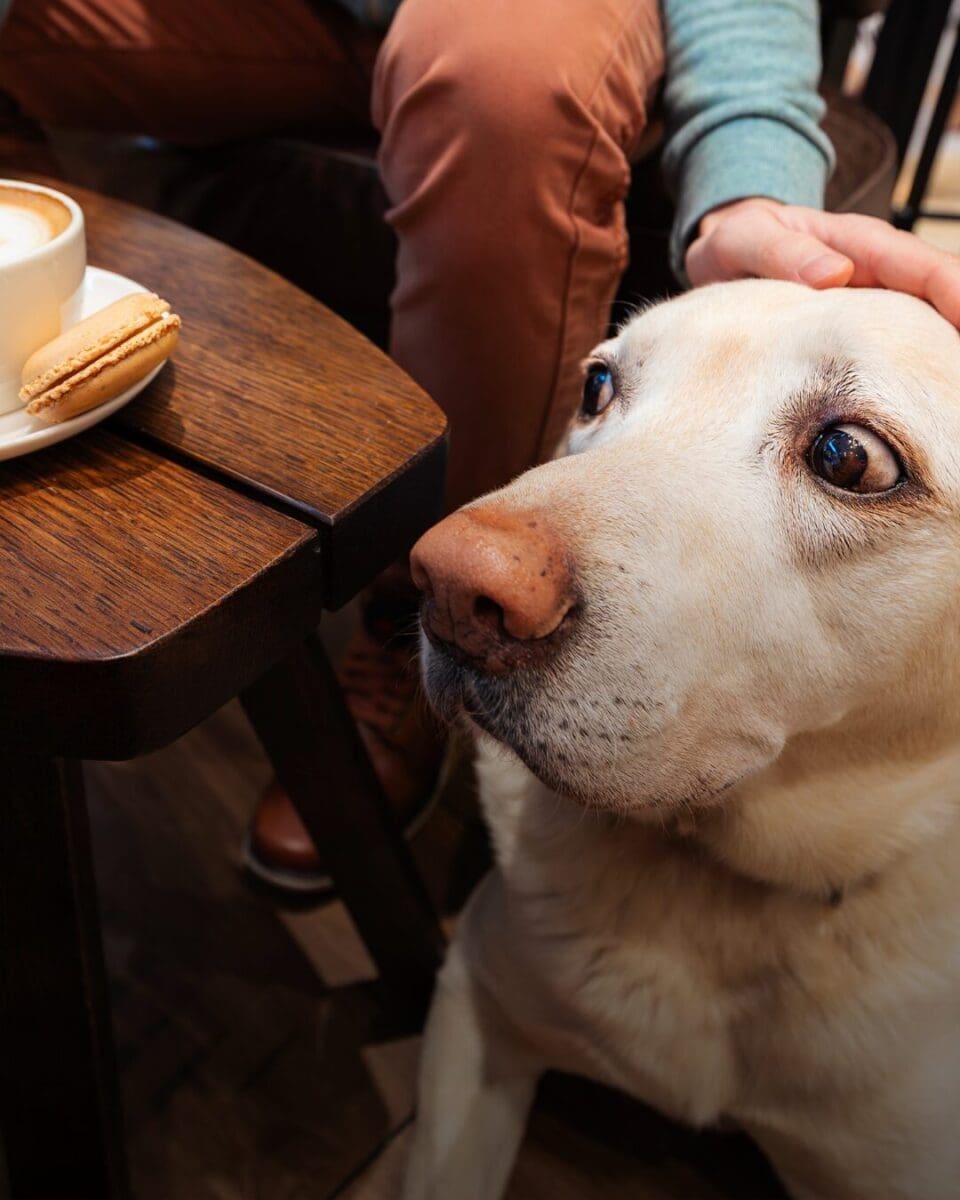
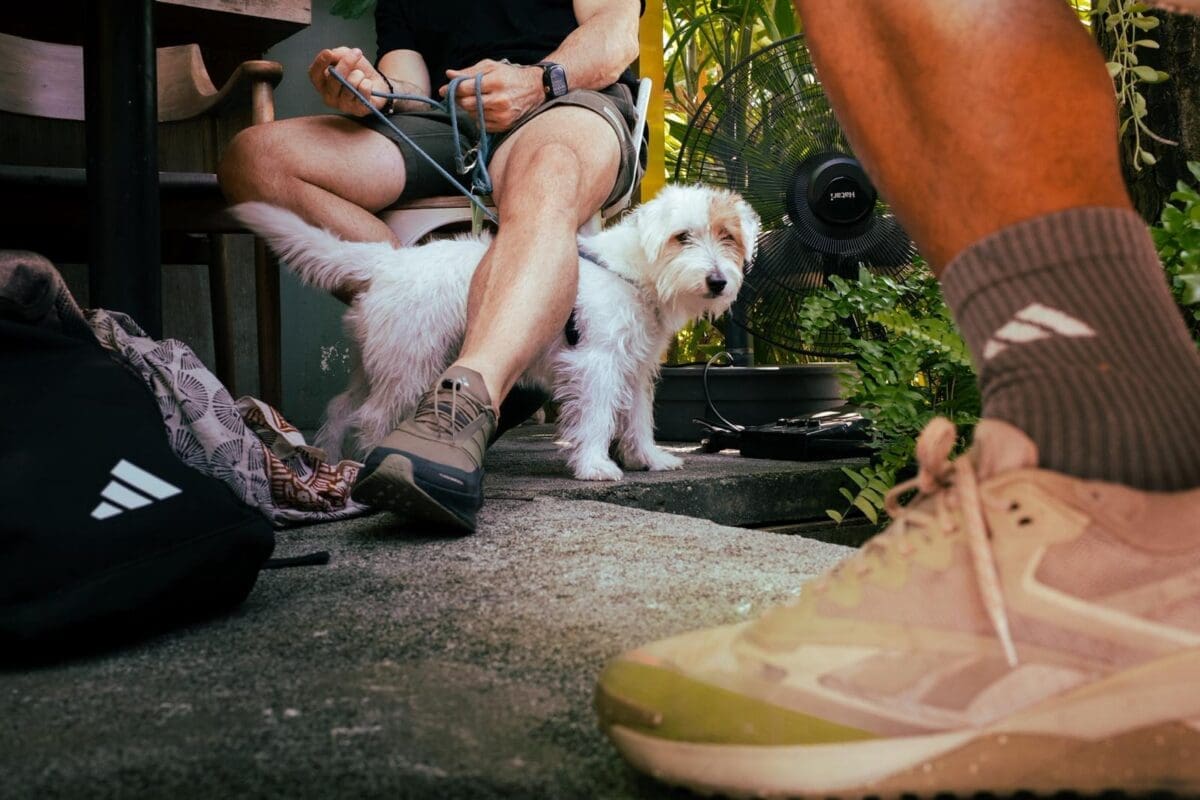
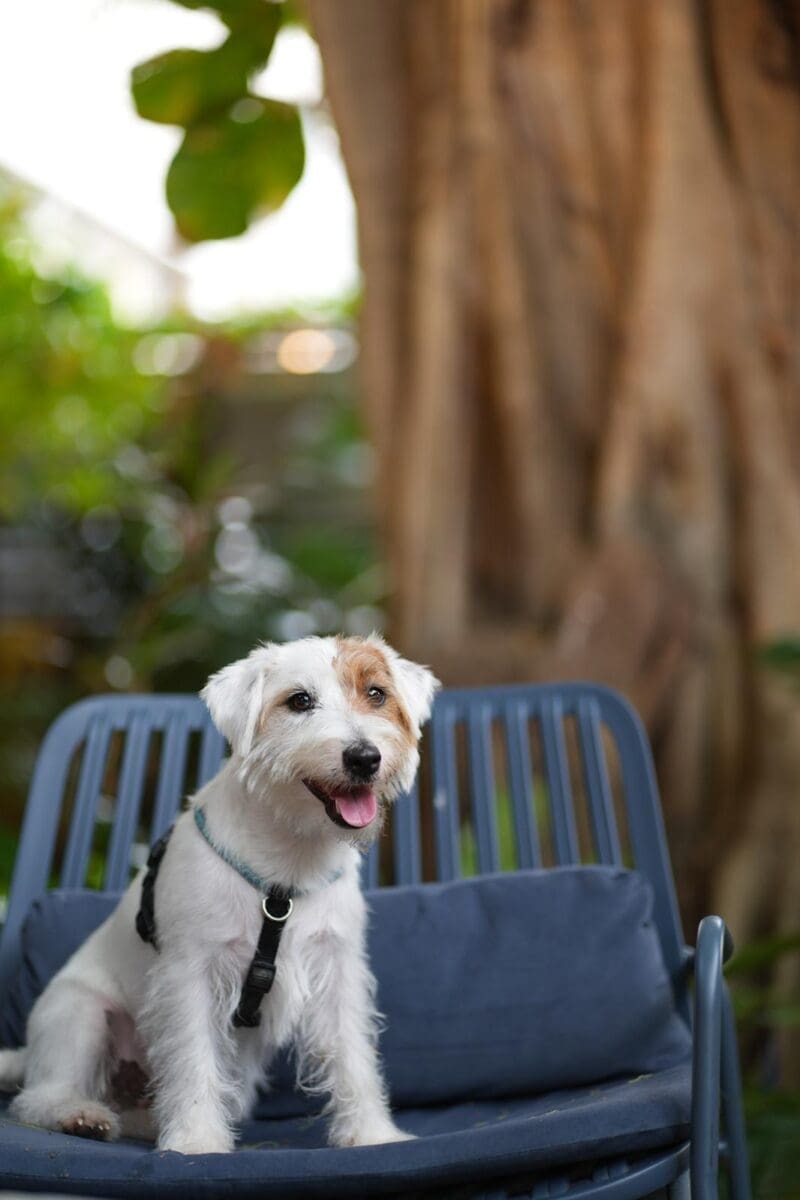
Here’s something worth saying directly: a cute photo is not evidence that your dog is enjoying themselves.
A dog posing on a café chair can be any of these things:
- Genuinely relaxed and enjoying it. Loose body, soft eyes, maybe even dozing.
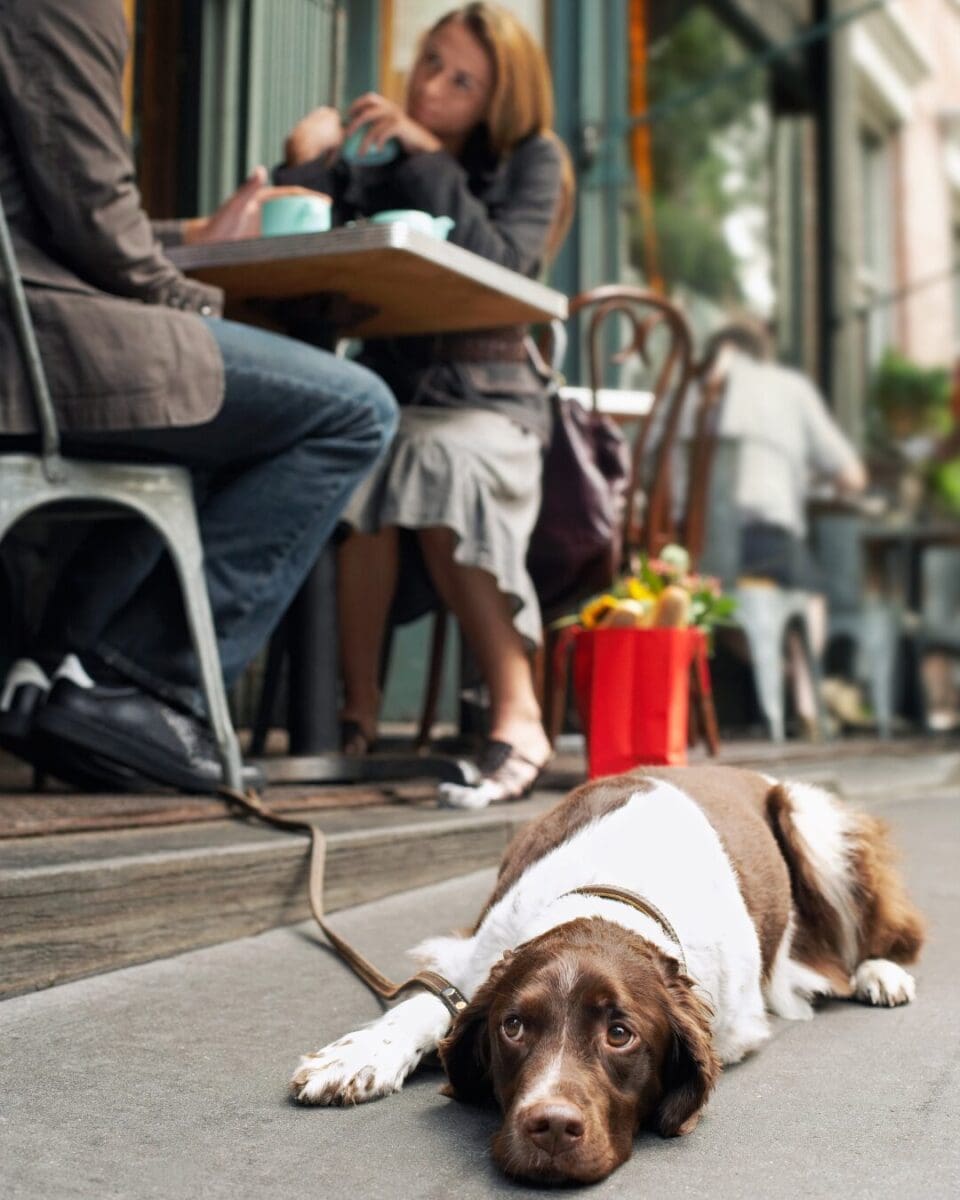
- Tolerating it because you’re there. Mildly stressed, but coping, because their person is the safe thing in the room.
- Shut down and waiting for it to be over. A withdrawal response, often misread as “calm.”
- Holding on until they can go home. Functioning, but not having a good time.
From the outside, and especially in a phone photo, these can look nearly identical. The photo captures one second. Your dog has been there for two hours. The photo is the highlight; the afternoon is the reality.
This is one reason social media is a tricky lens for thinking about dog welfare. The platforms reward the moment that looks good. They don’t reward the question of what came before, after, or underneath the moment.
Reading the dog: the work of Turid Rugaas
If we want to actually answer what is this like for them?, we have to learn to read what they’re telling us. And here, the indispensable resource is the work of Turid Rugaas, the Norwegian dog trainer and behaviourist who has spent decades studying how dogs communicate when they’re under stress.
In her now-classic book On Talking Terms with Dogs: Calming Signals, Rugaas argues that dogs have a rich, mostly silent vocabulary of signals they use to defuse tension and communicate that something is too much. She estimates dogs use around thirty of these signals, sometimes more. Most are subtle. Most are missed by the people they’re being used on.
A few of the most common ones, drawn from her work:
- Yawning when not tired. Often the clearest single signal. A dog yawning in a quiet café isn’t bored – they’re regulating themselves.
- Lip-licking. A quick flick of the tongue across the nose. Easy to miss; almost never accidental.
- Turning the head or body away. A polite “I’d like some space, please.” If a dog turns away from a stranger reaching toward them, that is a complete sentence.
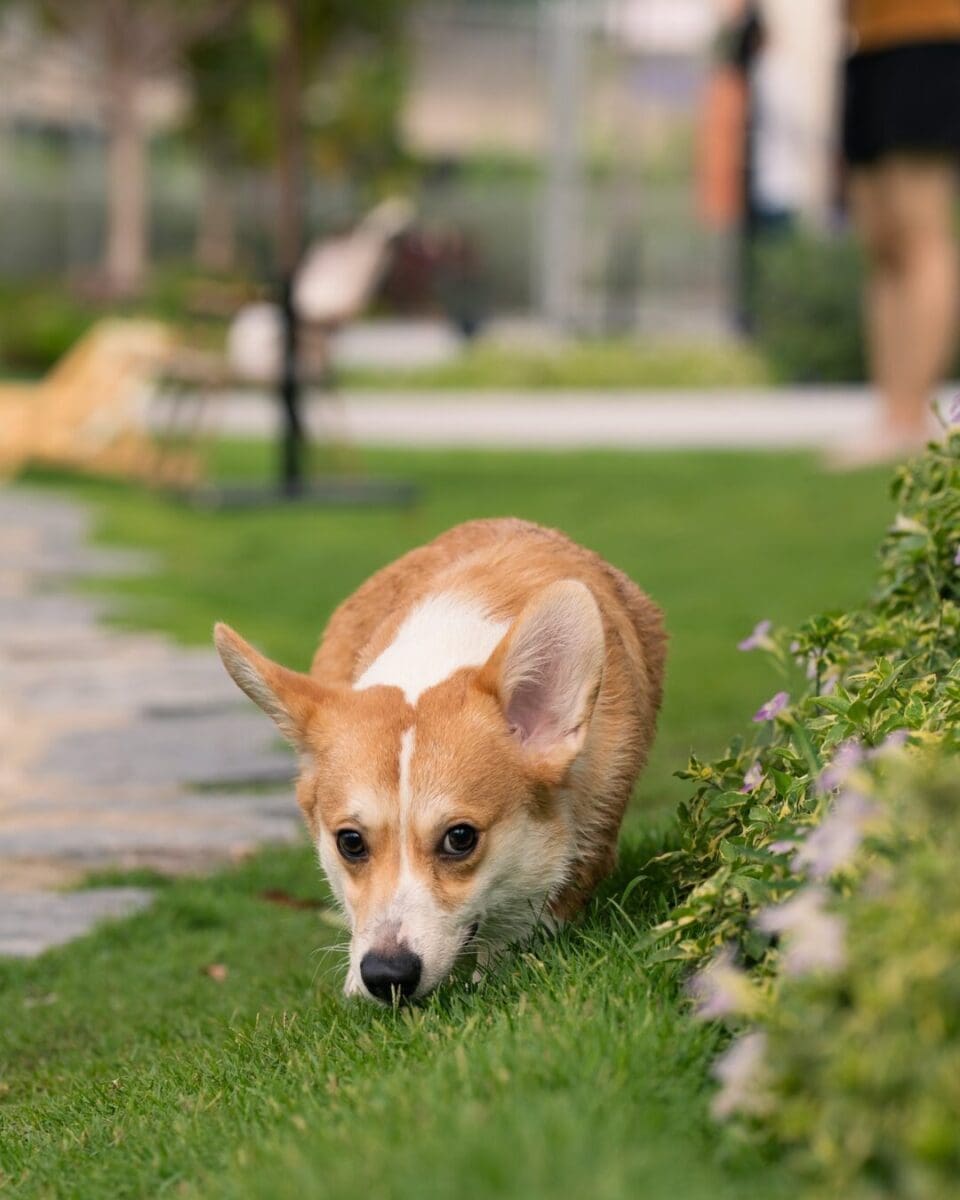
- Sniffing the ground in a tense moment. Dogs sniff for many reasons, but a sudden ground-sniff in an awkward situation is often a calming gesture, not curiosity.
- Refusing food they’d normally take. A dog who won’t take a treat at a café – when they would absolutely take that treat at home – is telling you something specific. Cortisol, the stress hormone, suppresses appetite. Their stomach has the answer their face is hiding.
Rugaas describes these signals as the dog’s quiet way of saying “this is a lot.” They aren’t dramatic. They aren’t easy to film. But they’re there, and once you learn to see them, you can’t un-see them.
A note worth saying clearly: these aren’t verdicts. A single yawn doesn’t mean the outing is a failure, and a dog who lip-licks once isn’t suffering. What matters is the pattern. A dog who is repeatedly showing several of these signals across an outing – yawning, turning away, refusing food, sniffing the ground when nothing’s there to sniff — is not having the afternoon you think they’re having.
This is information. Useful, actionable, free information. Your dog has been giving it to you the whole time.
The shift we’re asking for: plan around your dog
Most of us plan our day from our side first. Where am I going? What am I doing? When? With whom? And then, somewhere near the end of that thinking, we ask whether the dog can come along.
 A dog-first approach starts somewhere else. It starts with reading the dog you actually have today – not the dog you wish you had, not the dog the photos show, not the dog who handled it last week. The dog in front of you, this morning. Then, and only then, you decide what fits.
This is a smaller shift than it sounds, in the sense that it doesn’t ask you to change your life. You’re still going to the café. You’re still meeting friends. You’re still living in the city.
It’s also a bigger shift than it looks, in the sense that it changes who is at the centre of the decision. The dog stops being a guest in your plan and becomes part of how the plan gets made. Some days that means they come. Some days that means they don’t. On the best days, the question doesn’t even feel hard, because you’ve been paying attention all along.
The pause is the whole thing
There’s a difference between bringing your dog along and actually thinking about them before you do.
The first is automatic. You grab the leash, they come along, the day proceeds. There’s nothing wrong with this; most outings happen this way, and most of the time it’s fine.
fine.
The second takes a moment of pause. Is this for them, or for me? What kind of day have they had? What kind of day will this be for them, given the dog they actually are?
That pause – small, brief, almost invisible from the outside – is the entire difference. It’s the difference between treating your dog as part of your life and treating them as a participant in their own. Between assumed enjoyment and observed enjoyment. Between bringing them along and being with them.
It’s not a high bar. It’s just a question worth asking. And asking it, regularly, is what dog-first looks like in practice.
Over to you
When was the last time you stopped, before an outing, and asked yourself what it would actually be like for your dog? What did you notice?
Share this with a Bangkok dog owner who might find it useful.
References & further reading
The ideas in this piece draw on the foundational work of two writers we return to often, plus current ethical animal welfare research. If you’d like to go deeper:
- Horowitz, A. (2009). Inside of a Dog: What Dogs See, Smell, and Know. Scribner. The book that introduced a generation of dog owners to the concept of umwelt — the dog’s own sensory world. Indispensable for understanding what your dog is actually experiencing.
- Horowitz, A. (2016). Being a Dog: Following the Dog Into a World of Smell. Scribner. A deeper look at the olfactory life of dogs, and a persuasive argument for why their world is built primarily out of scent.
- Rugaas, T. (2006). On Talking Terms with Dogs: Calming Signals (2nd edition). Dogwise Publishing. The foundational text on canine body language as a communication system. Short, clear, and life-changing for most dog owners who read it. Author’s website.
- Mellor, D. J., Beausoleil, N. J., Littlewood, K. E., McLean, A. N., McGreevy, P. D., Jones, B., & Wilkins, C. (2020). The 2020 Five Domains Model: Including Human–Animal Interactions in Assessments of Animal Welfare. Animals, 10(10), 1870. Read here
- Littlewood, K. E., Heslop, M. V., & Cobb, M. L. (2023). The agency domain and behavioral interactions: assessing positive animal welfare using the Five Domains Model. Frontiers in Veterinary Science, 10, 1284869. Read here